10 Calm Ocean Facts to Help You Fall Asleep: Gentle Bedtime Reading with Narrated Videos
The lights are low, the day is behind you, and your mind is still busy. These calm ocean facts are a gentle way to settle in and calm your mind before bed. Each one is true and written to help you wind down: ten relaxing ocean facts for sleep and bedtime relaxation. You will drift through golden kelp forests, watch sea otters hold paws as they rest, and follow a whale’s song across an entire ocean. There is nothing to memorize, just calming nature facts and gentle ocean imagery to give your thoughts somewhere quiet to land.
Think of it as soothing bedtime reading, a sleep story for adults. These gentle facts to fall asleep to are meant to quiet the mind and ease you toward peaceful sleep. Slow-paced reading can be a simple form of mindfulness before sleep, and many people find that a quiet bedtime routine helps them fall asleep faster, though everyone is different. Each fact comes with a short video in a soft, narrated voice, so you can read, listen, or do both.
Fact 1: A Golden Forest Grows Beneath the Waves
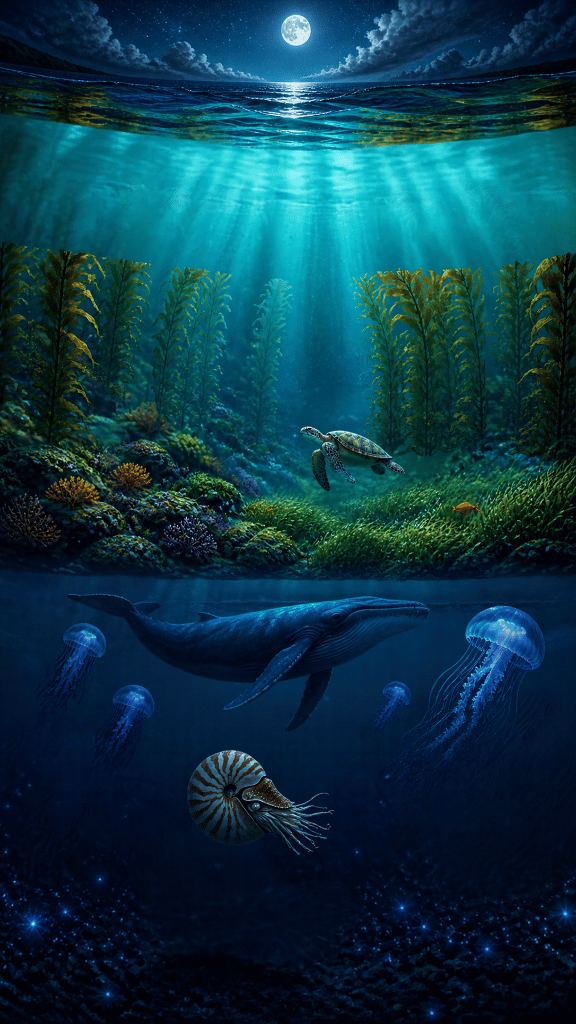
Let your breathing slow. Along certain cool coastlines, a forest rises from the seafloor where no tree has ever grown. Tall golden-green strands sway slowly in the current, and sunlight drifts down through them in soft, moving beams that shimmer and shift as the water rocks. This is a giant kelp forest, one of the most peaceful sights in the sea.
Not a Plant at All
Kelp is not a plant. It is a huge kind of algae, with no roots in soil and no leaves in the air. It simply holds onto the rocks below and reaches for the light. It anchors, and it reaches, and that is all it needs to do.
And it reaches quickly. Giant kelp can grow up to 18 inches in a single day, faster than almost any plant on land. While the world sleeps, a strand somewhere in a cool coastal sea may be stretching a little closer to the sunlight, without a sound.
Some strands stretch to 150 feet, taller than a 15-story building. Small gas-filled bladders along each strand keep it floating upright, like tiny balloons holding up the canopy, so the forest can sway in the light instead of sinking to the seafloor.
A Shelter for Every Kind of Creature
Beneath the swaying leaves, a whole world finds shelter. Fish hide in the cool shade. Seals glide slowly through the gaps between the strands. Sea otters wrap themselves in kelp so they will not drift away while they rest, which makes the kelp a living blanket as well as a hiding place.
Countless tiny creatures live on every blade. Even the smallest corners of the forest are full of quiet life.
A Living Cathedral
Many people call a kelp forest a living cathedral beneath the waves, and it is easy to see why. Imagine looking up through the strands as the light moves across the water. Light falls from above in soft columns. Tall, graceful shapes rise on every side. Everything moves slowly, as if the whole place were breathing. It was built entirely by algae, and it is quietly filled with life.
There is nothing to rush toward here. The forest grows at its own pace, and so can you. When you are ready, let the current carry you onward to the next quiet wonder of the sea.
Fact 2: A Quiet City Built by Tiny Animals
Let your shoulders soften. Imagine drifting over a coral reef in warm, clear water. Sunlight ripples across the coral, and everything is quiet. Fish glide past like slow, shimmering thoughts, and the colors below seem almost too beautiful to be real.
Not a Rock at All
A coral reef is not a rock. It looks like colorful stone, but something much softer built it. Beneath the gliding fish, millions of tiny animals called coral polyps are hard at work. Each polyp is small, often no bigger than a pencil eraser. Imagine something that small, resting in the warm water, doing its quiet work without any hurry.
Each polyp pulls calcium from the seawater and turns it into a hard, stony cup to live in, a small home made from the sea itself.
Layer by Layer
When a polyp dies, its cup stays behind. A new polyp settles on top and builds again, then another, and another. Layer by layer, year after year, a reef rises.
It is a very slow kind of growth. Some reefs grow only a few inches in a year, and some have been growing for thousands of years. There is a gentle comfort in knowing that something so vast was made one tiny layer at a time, with no rush and no deadline.
Part Animal, Part Mineral, Part Home
So what is a reef? It is an animal, because it is alive. It is a mineral, because it is made of stone. And it is an ecosystem, because so many creatures call it home. It is a little of each, all at once.
Reefs cover less than 1% of the ocean floor, yet more than 25% of all marine life depends on them. Picture a small, glowing place in the vast, dark sea, sheltering a quarter of the ocean’s living creatures. It is a slow city built entirely by life, where every home was shaped by the ones who came before.
You are in no hurry tonight. When you are ready, let the water carry you onward to the next quiet wonder of the sea.
Fact 3: A Green Meadow Grows Beneath the Sea
Let your body grow heavy. In shallow, quiet water, green blades sway back and forth, rolling across the sand like a field in the wind. There is no hurry in their movement, only a soft, steady rhythm, as if the whole meadow were breathing with the water.
True Flowering Plants
These meadows are made of seagrasses, and they are not seaweed. Unlike the kelp in Fact 1, which is a kind of algae, seagrasses are true flowering plants, with roots, leaves, and even seeds. Somewhere along the way, they found their way back to the sea and made themselves at home.
Their roots hold the seafloor in place, so sand and mud do not drift away. Their leaves slow the waves and help clear the water, leaving it calmer and cleaner than before. The meadow asks for nothing in return. It simply grows, steadying the world around it.
Shade for the Young and the Slow
In the soft green shade, young fish hide and grow, safe among the blades while they gather their strength. Sea turtles graze here, unhurried and content. Manatees drift through slowly, munching in peace. Imagine sunlight filtering down, green blades swaying, and a manatee gliding past in no particular rush.
Blue Carbon
Here is the most magical part. Seagrass meadows cover less than 1% of the ocean floor, yet they store a huge amount of carbon. As the plants grow, they take in carbon dioxide. When old leaves and roots settle into the mud, there is very little oxygen there, so they break down slowly. The carbon can stay locked away for hundreds, even thousands of years. Scientists call it blue carbon.
Think of it as the meadow quietly tucking something away for safekeeping, layer by layer, in the soft mud beneath the water. Nothing dramatic happens. It is slow, patient, and steady.
So the next time you see a calm, quiet bay, remember that beneath the surface, a gentle green meadow may be quietly caring for the whole coast. You do not have to do anything tonight. Like the seagrass, you can simply rest, rooted and steady. When you are ready, let the current carry you onward to the next quiet wonder of the sea.
Fact 4: Sea Otters Hold Hands While They Sleep
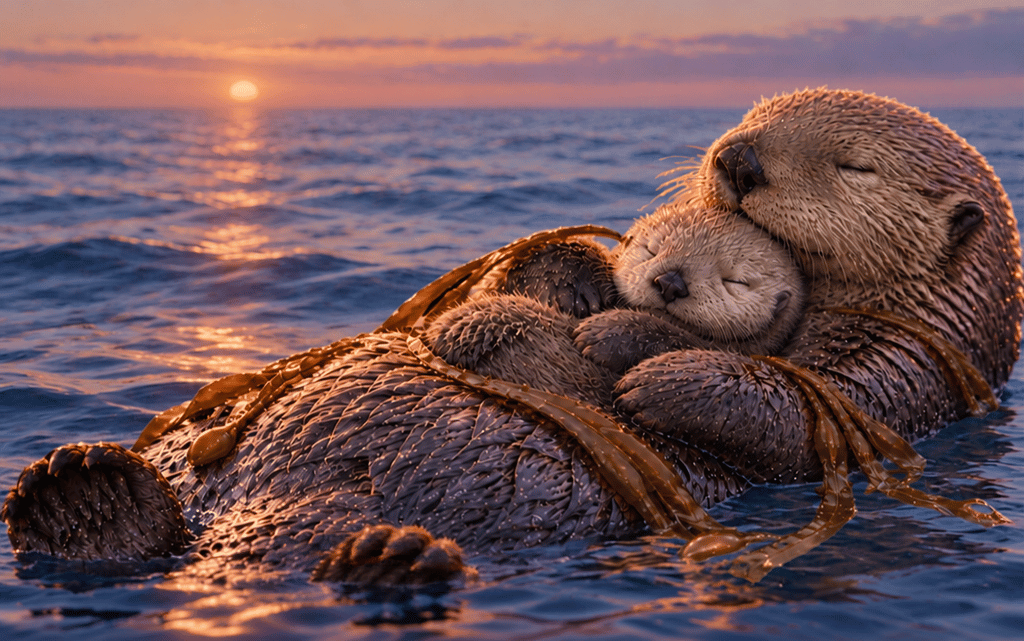
Let your hands rest softly. This is one of the sweetest facts in the ocean, and it is also very smart. Picture a calm sea at dusk, the water rising and falling in slow, wide swells. Out on the surface, a sea otter floats on its back, paws folded over its chest, eyes closed. It looks perfectly at peace, and in this moment, it is.
Anchored Like a Boat at a Dock
But the ocean never stops moving. Currents and tides can carry a sleeping animal far from where it started, so otters have a clever trick. Many of them wrap themselves in kelp. Kelp grows from the seafloor, held down by strong roots called holdfasts. When an otter winds a few long blades around its body, it becomes anchored, like a boat tied to a dock. The sea can rise and fall all it likes, and the otter stays where it is.
Holding On to Each Other
When there is no kelp nearby, otters hold paws with each other. Imagine two small, furry sleepers drifting side by side, their paws linked, floating together on the quiet water.
Groups of resting otters are called rafts, and they can include mothers and pups. A mother will often keep her baby close on her chest as she floats, rocking gently with the swells. It is a small family, safe and together, with nothing to do but rest.
The Thickest Fur of Any Animal
Their fur helps too. Sea otters have the thickest fur of any animal, with about 1 million hairs in a single square inch. Tiny air bubbles trapped inside keep them warm and floating. Even in cool water, they are wrapped in a soft, buoyant blanket that holds the warmth close and lifts them gently on the surface. It is a cozy coat of air and fur, rising and falling with the sea, carrying an otter through the night.
So the next time the sea feels too big, remember the otters, holding on gently and drifting together. When you are ready, let the swells carry you onward to the next quiet wonder of the sea.
Fact 5: A Sea Turtle Remembers Home in the Earth’s Magnetic Field
Let your eyes grow heavy. On a moonlit beach, a tiny hatchling, no bigger than your palm, crawls across the cool sand toward the sea. The night is quiet. The moon is soft. And this small traveler is just beginning a very long journey. It has no map. It has no mother to follow. Yet in those first quiet hours, scientists believe it learns something very special.
A Magnetic Signature
Every stretch of coastline has its own gentle magnetic signature. The strength and the angle of the Earth’s magnetic field are a little different from place to place, so each beach feels slightly unlike any other.
The hatchling seems to remember the feel of its own beach, like a soft song it will hear again someday. Imagine a melody learned in the very first hours of life and tucked away, patient and unhurried, to be recognized many years later.
An Invisible Compass
Then the hatchling swims out into the wide, open ocean. For years, it drifts along great currents, traveling thousands of miles. The water carries it onward, slow and steady, while the world turns beneath the stars.
Experiments show that young turtles can sense the direction of the magnetic field and use it to stay on a safe path, almost like an invisible compass. Picture a small shape gliding through open water, guided by something no one can see.
The Journey Home
When the turtle is grown, something beautiful happens. After 20 or even 30 years, she often returns to nest near the very place where she was born. Take a moment to let that settle. Decades have passed, she has crossed thousands of miles of open sea, and still she finds her way back to the shore of her beginning.
There is no map and no voice calling her home. There is just the planet itself, humming softly beneath the waves, and a sense of belonging that never fades. Home, for the sea turtle, is not only a place on the sand. It is something remembered, something carried quietly through the dark and the distance.
However far she drifts, the way back is still there, waiting in the Earth itself. When you are ready, let the tide carry you onward to the next quiet wonder of the sea.
Fact 6: A Whale’s Song Can Travel Across an Entire Ocean
Let your jaw soften. In the dark blue quiet, far below the surface, a blue whale floats in the stillness. There is no hurry here, only deep water and the soft hush of the sea. The whale sends out a deep, slow note, so low that you would feel it more than hear it. It does not rush outward. It rolls through the water like a long, gentle swell, spreading wider and wider into the dark.
Why Water Carries Sound So Well
Sound moves far better in water than in air. It travels about 4 times faster, and it fades much more slowly. That means a sound made in the ocean can keep going long after a sound in the air would have faded away.
Think of how a quiet voice disappears across an open field. In the sea, that same voice would linger and travel, carried onward by the water itself.
A River Made of Sound
There is something even more magical. About 1,000 meters down, there is a layer of ocean where sound moves a little slower than anywhere else. Sound waves bend toward this layer and get gently trapped inside it, like a river made of sound. Scientists call it the deep sound channel.
Picture an invisible stream flowing through the dark, holding every note softly within its banks. Inside it, a whale’s call can keep traveling for hundreds of kilometers.
A Vast, Slow Conversation
Underwater microphones called hydrophones can catch these songs from very far away. One song may reach another whale across a distance that would take a ship days, or even weeks, to sail. A single slow note, sung into the deep, drifts patiently across the open ocean until it finds someone listening.
The ocean is not empty at all. It is a vast, slow conversation, with voices drifting through the dark and finding one another, one soft note at a time. Far-off voices, unhurried and gentle, reaching across great distances to say, in their own way, that they are here.
Even in the deepest, quietest places, something is being said, and something is being heard. When you are ready, let the deep water carry you onward to the next quiet wonder of the sea.
Fact 7: Where the Ocean Makes Its Own Light
Let your hands grow heavy. Begin at the shore, on a quiet night, with the dark water stretching out before you. A small wave rolls in, and the water glows blue. Tiny drifting cells called dinoflagellates flash when the wave moves them. Each spark lasts only a moment, but together they paint the foam in soft, glowing blue. Imagine watching from the sand as the wave folds over and pale light shimmers through it, fading as quietly as it came.
Sinking Into the Dark
Now let yourself sink. The sunlight fades, and the water turns deep blue, then black. But it is not empty. In the open ocean, about 3 out of 4 animals living below the surface can make light. Down here, glowing is a language. Some animals use light to hide, some to lure, some to talk, and some to escape.
Four Ways to Use Light
To hide: A hatchetfish lights up its belly to match the faint glow from above, so no hunter below can see its shadow. It disappears by glowing, blending into the dim light overhead.
To lure: The anglerfish dangles a glowing bulb filled with helpful bacteria, like a lantern in the dark. Picture that small, steady light hanging in the black water, patient and still.
To talk: Little sea creatures called ostracods leave glowing trails in the water to call to one another. Imagine thin threads of light drifting through the darkness, each one a soft message saying, “I am here.”
To escape: A vampire squid releases a cloud of glowing mucus, then slips quietly away. While the glow lingers, the squid is already gone.
Life Lights Its Own Way
The deep sea is the largest habitat on Earth, and in all that darkness, life lights its own way. Picture a vast, quiet blackness, scattered with small, gentle lights, each one with its own purpose. The dark is not something to fear here. It is simply the place where the lights shine most clearly.
There is something deeply restful in that. Each light is small, and each one is enough. When you are ready, let the water carry you onward to the next quiet wonder of the sea.
Fact 8: An Ancient Traveler Drifts Through the Sea
Let your arms grow loose. An ancient traveler is drifting through the ocean right now. It has no brain, no heart, and no bones. It is a jellyfish, and it has been here for hundreds of millions of years, long before the first animal ever walked on land, and even long before the dinosaurs. Take a moment to sit with that. Whole ages have come and gone, and this soft traveler has simply kept floating along.
Finding the Way Without a Brain
So how does a jellyfish move through the world without a brain? It uses a soft net of nerves that spreads through its whole body. There is no single center giving orders, only a gentle web of feeling woven through every part of it.
Tiny light-sensing spots help it notice bright and dark water. Little balance organs tell it which way is up. That is enough to guide it, pulse by pulse, through the quiet blue. It does not need more than that. It simply drifts, and it knows its way.
A Slow Breath of a Body
A jellyfish’s body is almost all water. It has no heart to beat, so its bell simply opens and closes, again and again, like a slow breath. Open, and close. Imagine a soft, glowing bell rising and falling in the dim blue light, steady and unhurried. If you like, let your own breathing fall into that same easy rhythm.
The Immortal Jellyfish
Here is the gentle twist. One tiny kind, called the immortal jellyfish, can do something amazing. When it is hurt or old, it can turn back into a young polyp and begin its life again. It is a beginning-again, with no ending that cannot become a start. It is one of the gentlest ideas in the sea, and it is real.
So the next time you picture the ocean, remember this calm, glowing traveler: simple, soft, and still here after all this time. It has no hurry and no worry. It has only the water, the light, and the slow rhythm of its own bell. When you are ready, let the water carry you onward to the next quiet wonder of the sea.
Fact 9: A Living Spiral Rises Through the Deep
Let your whole body grow heavy. This is the last of our gentle ocean facts. Far below the waves, in a soft, dim sea, a living spiral glides out of the darkness. It is the chambered nautilus, and it has barely changed for hundreds of millions of years. It moves without any hurry, as if it has all the time in the world. It carries a shell that curls like a quiet song, round and round, each turn a little wider than the last.
Room by Room
As the nautilus grows, it builds a brand-new chamber at the front of its shell. Then it seals off the old one behind it. Room by room, the spiral gets bigger, like a record of every season it has lived. It is a home that grows with you, keeping each earlier chapter tucked safely behind a quiet wall. Nothing is thrown away. Everything becomes part of the shape.
A Floating Engine With No Motor
Those sealed rooms are not empty. They hold gas and a little fluid, and the nautilus can adjust that balance. Think of it as a tiny floating engine, with no motor at all. With a gentle change inside its shell, it can rise or sink through the water, as softly as a thought.
When night falls, it rises slowly from the deep, sometimes hundreds of meters up, toward shallower water. There, it drifts along and hunts for small crabs and shrimp. Then, as morning comes, it sinks back into the cool, dark water below. Up in the night, down in the day, again and again, a rhythm as steady as breathing in and breathing out.
A Shell That Is Also a Story
Nautiluses were here before the dinosaurs, and every night, they still rise through the same calm sea, wrapped in a shell that is also a story. Seasons have turned, ages have passed, and still the spiral glides upward at dusk and settles back down at dawn. In a world that is always changing, here is a creature that keeps its own gentle rhythm, growing one quiet chamber at a time.
There is nothing to hurry tonight. Like the nautilus, you can rise and settle in your own time. When you are ready, let the water carry you onward to the final quiet wonder of the sea.
Fact 10: The Ocean Has Its Own Snow
Let your breath grow slow. This is the last of our gentle ocean facts. Imagine floating deep in the ocean, where it is dark and still. Then something small drifts past you, and another. It looks like snow, falling softly through the quiet water.
A Desert That Is Not Empty
For a long time, people believed the deep sea was empty, a cold, dark desert with nothing in it. But the deep is never empty. High above, in the sunlit water, tiny plankton live, and when they die, they begin to sink. Bits of shell, tiny scraps of animals, and fine organic dust sink with them. Scientists call it marine snow.
The life of the bright water above does not simply disappear. When it ends, it begins a long, slow journey downward.
Snow Made From Life
Marine snow is not cold, and it is not frozen water. It is made from life. Many of the flakes clump together as they fall, so a flake can be far larger than any single piece that formed it, and some grow as big as a few inches across.
The smallest ones can take weeks to reach the bottom, and some drift for even longer than that. It is a silent snowfall that never really stops, drifting down through the still water with no sound at all.
A Soft Landing and a Quiet Meal
Down on the seafloor, the snow settles softly. Sponges, corals, sea cucumbers, and worms wait for it. These animals live in a place the sun has never touched, and their meal comes from a world they will never see.
Nothing is chased or caught here. Everything they need arrives from above, one gentle flake at a time. For these animals, the deep is not a desert at all. It is a place that is fed, quietly and continually, from the water far overhead.
So the next time you watch snow fall outside, remember that the ocean has its own. It falls every day, in the dark, feeding the deep.
You have traveled far tonight, through golden kelp forests, quiet reefs, green meadows, moonlit shores, and the deep, dark sea where the snow falls. Each of these calm ocean facts is a small reminder that rest is part of nature’s rhythm too.
Creating Your Ocean Bedtime Ritual
A simple wind-down routine can make reading even more restful. Here are a few ideas to pair with these facts.
- Keep a consistent bedtime, even on busy days
- Dim the lights 1-2 hours before bed
- Choose a fact that fits your mood and read it slowly, pausing between sections
- Close your eyes and listen to its video, picturing the scene
- Breathe slowly, letting each breath rise and fall like a gentle wave
- Jot down the fact that surprised you most, or one thing you’re grateful for from the day
- Put screens away once you’ve finished reading or listening

Remember, winding down with calm ocean facts is a practice. Don’t get discouraged if your thoughts wander to tomorrow’s to-do list, or if you lose your place. Simply notice where your mind has gone and gently return to the fact, picturing the water, the light, or the slow movement of the sea, just as a tide drifts out and always finds its way back. It’s all part of the process.
Drifting Into Sleep With Calm Ocean Facts…
You have traveled a long way tonight. You drifted through golden kelp forests and quiet coral reefs, over green seagrass meadows and moonlit beaches, and down into the glowing deep. Each of these calm ocean facts offers the same quiet reminder: the sea is full of slow, patient wonders, and rest is part of nature’s rhythm too.
Slow-paced reading like this can be a simple form of mindfulness before sleep. By settling your attention on gentle ocean imagery, you give your thoughts something calm to follow instead of the worries of the day. For many people, that makes it easier to quiet the mind, ease into bedtime relaxation, and drift toward peaceful sleep. It is not a cure, and if sleeplessness keeps returning, a doctor can offer support that a bedtime read cannot.
Come back to these relaxing ocean facts whenever you need to wind down, or bring a little of the shoreline home with a coastal relaxation retreat. Let the waves carry your thoughts out, one slow breath at a time, and let deep, restorative sleep find you in its own gentle time.
Goodnight, and sleep well.
Calm Ocean Facts for Sleep FAQ
What are calm ocean facts?
Calm ocean facts are true, gentle stories about the sea, told in a soft, soothing tone. They focus on peaceful subjects like drifting jellyfish, swaying kelp, and glowing waves instead of dramatic or frightening topics. Because they are real science told softly, they make calming nature facts that hold your attention without stirring up your thoughts. They are meant to be read slowly, one at a time.
Can reading ocean facts before bed help you fall asleep?
A quiet routine can help your mind and body wind down at night, and gentle reading is a popular part of it. Ocean facts for sleep give you something peaceful to think about instead of the day’s worries. A calm setting helps too, so consider creating a plant-enhanced sleep sanctuary. Everyone is different, so treat it as a ritual, not a cure.
Are the facts in this post true?
Yes. Every fact is grounded in real marine science, and the wonder comes from the way it is told. The videos include a touch of fantasy, such as a long-haired goddess, but that imagery is there only for atmosphere, and the facts themselves are true. A few are described with care where the science is still developing.
How should I read these ocean facts before bed?
Go slowly. Pause between sections, take a breath when a fact ends, and let your own rhythm set the pace. Some readers add a warm, caffeine-free herbal tea to the routine, and our guide to creating your perfect sleep tea ritual has ideas. If you are reading on a phone, lower the brightness or use night mode to keep the screen soft on your eyes.
Can I listen to these ocean facts instead of reading them?
Yes. Each fact includes a short video narrated in a gentle voice, so you can read, listen, or do both. If your eyes are tired, you can lower the brightness, close your eyes, and let the narration carry you through the fact. Starting with the video and reading the text afterward works well too. You can also play the whole calm ocean facts playlist in order. Each video is short, so it is easy to replay a favorite.
What can I listen to after these calm ocean facts?
Soft, slow calm music is a gentle next step once you finish reading, and you can pick a playlist to match your mood. Try the sleepy spring soundtrack for nature and dreams, the sleepy autumn soundtrack for home and gratitude, the sleepy love soundtrack for romance and acceptance, or the sleepy Christmas soundtrack for winter beauty and quiet dreams. Keep the volume low and let it fade out.
What if I still have trouble falling asleep?
Bedtime relaxation looks different for everyone. You might try dimming the lights, keeping a regular sleep schedule, taking slow breaths, or returning to a favorite fact. If you want to explore other options, our guide to natural sleep solutions covers patches, gummies, and supplements. If trouble sleeping continues, or you take medication, talk with a doctor first.